How GEO and AI Overviews changed Australian local business websites in 2025–2026
Hi, I’m Anton Sednin, Campaign Manager at Grid Concepts, and I want to talk about how GEO (Generative Engine Optimization) and Google AI Overviews have changed the way our marketing campaigns work in 2025–2026. All my conclusions are based on statistics from our clients in Melbourne, Brisbane, and Australia as a whole. Only real data, only hardcore.
(One housekeeping note: the charts through this piece are redrawn from our internal client dashboards for the new site - the figures match the originals, we’ve just re-plotted them so they read cleanly here.)
This content may sound a bit technical, so I’ll define the audience right away. This article will be of interest to you if:
- You’re also an SEO specialist, and you’re interested in how competitors like us have adapted to new AI trends.
- You’re an SME owner in Australia and you’re interested in how other small business owners’ websites are doing.
- You’re an SME owner and you’re currently at a crossroads, wondering whether to spend additional budget on GEO marketing (spoiler: it’s usually not a good idea).
So, the basic questions are:
- Should you spend money on GEO? (Spoiler: no.)
- Should you spend money on AEO? (Spoiler: yes.)
- How do you retain leads in 2026 and 2027?
Our answers to all three are below. Let’s go.
Is AI a good source of leads and traffic for local businesses in 2026?
In general, the answer is “no.”
But let’s get into the detail.
Many business owners in Australia experienced a sharp drop in traffic and leads in July–August 2025 - sometimes dramatically, as we’ll show below using one of our clients as an example. Meanwhile, all the talk around is “AI is the new global trend.” As a result, it’s tempting to spend money on GEO - in simple terms, optimising a website for neural-network sources of traffic.
So why not spend a little money to appear in ChatGPT?
Again: no.
Our team works with dozens of small and medium-sized business owners in Australia, with monthly traffic ranging from 3,000 to 500,000 visits. If you came to us for a consultation right now with this question, we’d likely tell you that GEO isn’t worth it. We received very few leads from neural networks in 2025–2026. Using AI-visibility testing services like keyword.com as a benchmark, we have local Australian business websites with strong visibility in ChatGPT where only 2 out of 100 monthly leads come from neural networks.
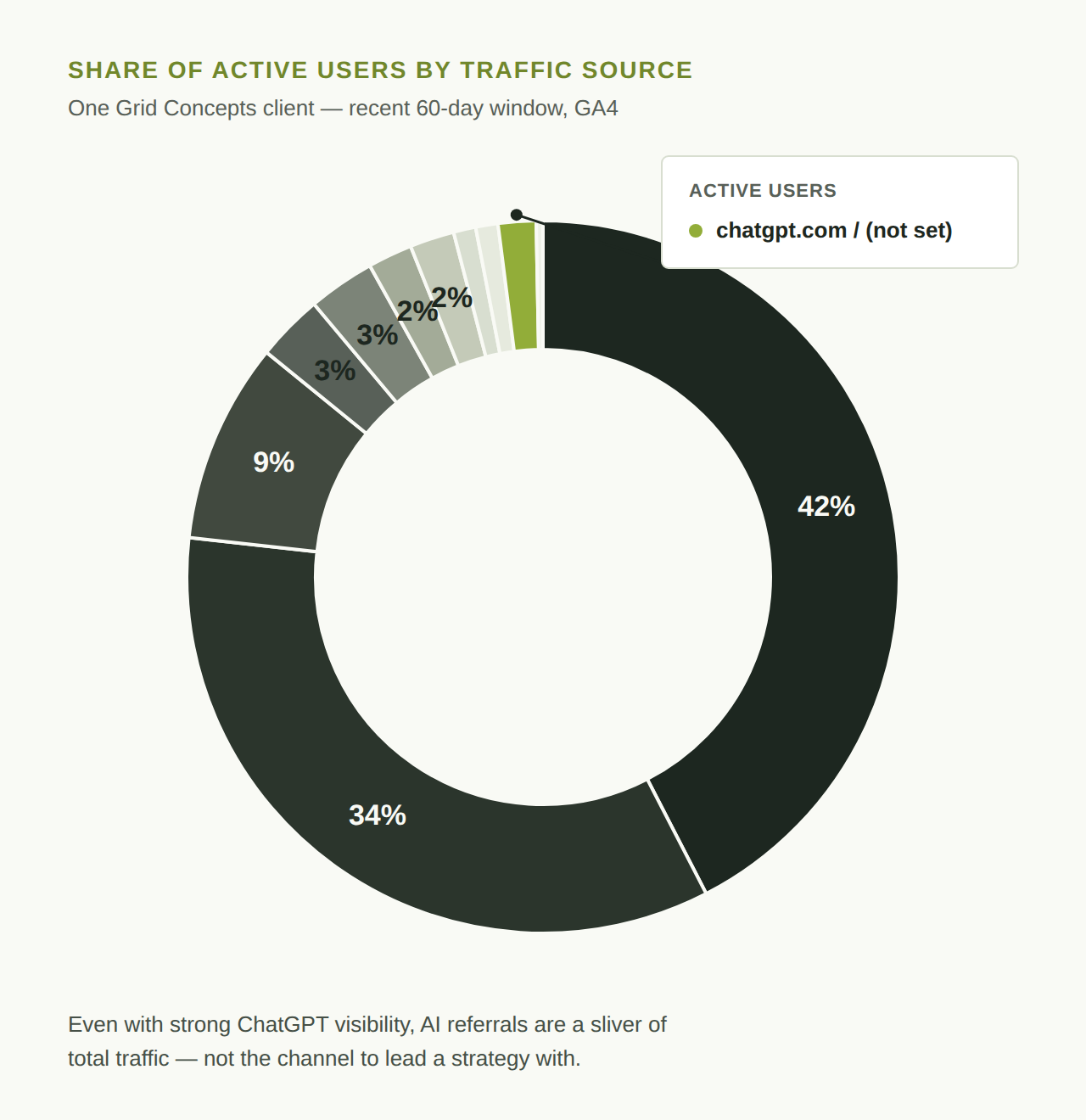
Pretty low, right? And this is one of the clients with good visibility in ChatGPT.
But ChatGPT isn’t the only neural network. So which other neural networks drive traffic for our clients? The top ones are:
- ChatGPT
- Perplexity
- Claude.ai
- Copilot.com
Yet ChatGPT brings in more traffic than all the others combined. Our largest client had 500,000 views last month, of which ChatGPT accounted for 1,500 - 0.3%. Incredibly low.
And no, it’s not because we’re bad at SEO (although how would you check that? Ha) - it’s simply because most SME owners’ websites are not well suited for GEO.
So should local business owners in Australia consider GEO?
More likely yes than no - but the hype is overrated. Here’s the paradox: if you ask ChatGPT right now, it will answer something like “Good idea! In 2026, GEO is important specifically for local businesses - go ahead!”
So what’s the contradiction?
When displaying information about local businesses, neural networks rely heavily on reviews and Google Maps. If you provide cleaning services in Melbourne and have the best reviews on Google Maps in your area, there’s a very good chance you’ll get mentioned by ChatGPT.
In other words, many business owners need to take care of their Google Maps profile and can largely forget about GEO as a separate spend.
Here’s the key thing local business owners need to understand: the trend toward focusing on location began long before GEO appeared, and Google has been emphasising the importance of local traffic for two years now.
Here’s some data from our clients that illustrates the point.
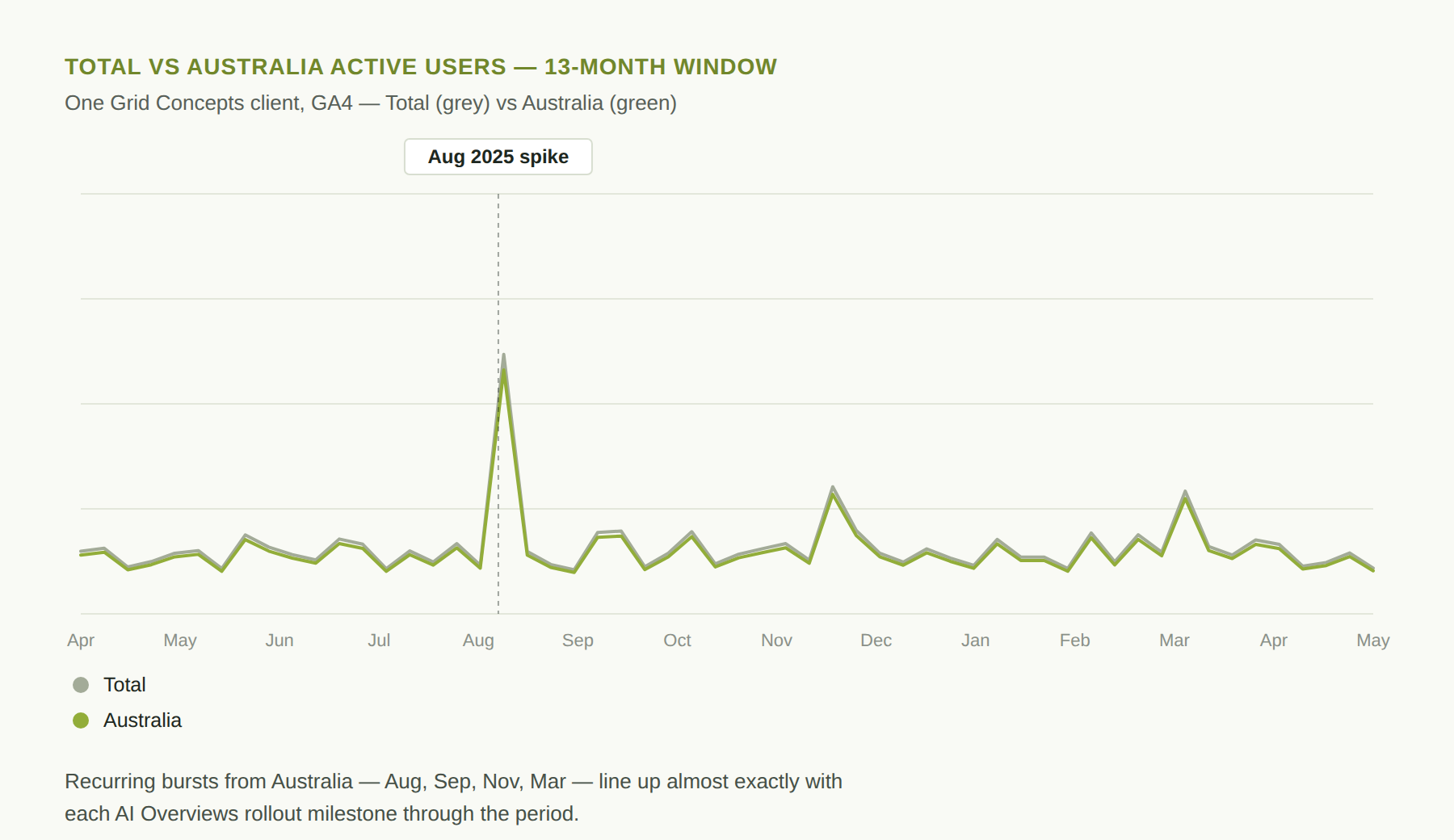
Client Example #1: traffic spikes from Australia began in August 2025.
Client Example #2: the site fell into a broader traffic recession in 2025, but traffic from Brisbane - the client’s primary location - held up, and even showed growth through 2025.
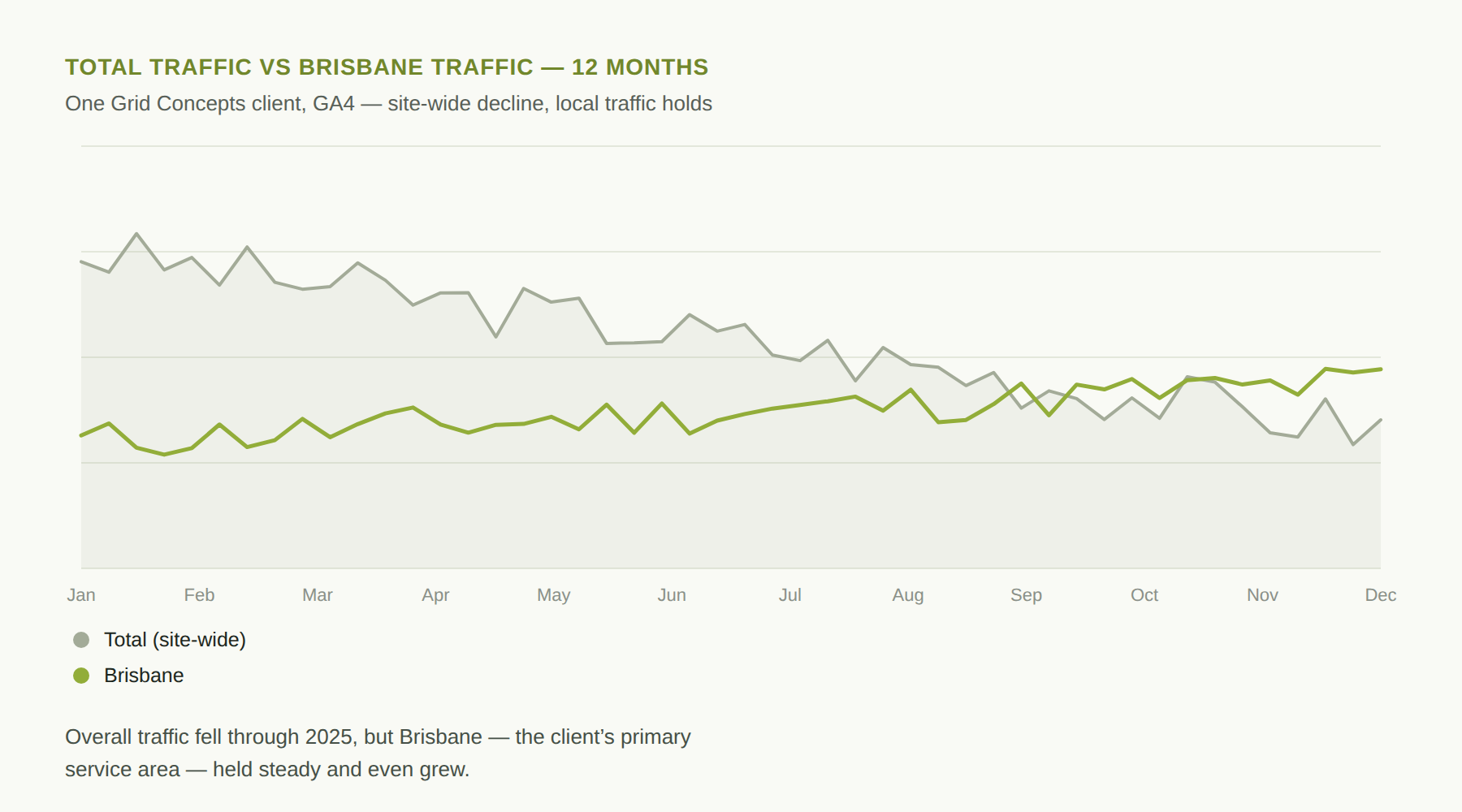
We’ve observed this trend for almost all of our Australian clients since late 2024. In the charts you can see growth spurts in August and September 2025 - right when AI Overviews rolled out more broadly. After a seasonal December dip, the trend continued through 2026.
So in 2026, the correct answer is: local businesses should prioritise demonstrating their local presence online more seriously, and only then think about GEO.
It’s worth understanding the difference between a local-signal trend and a GEO trend, because it changes which levers you should actually pull.
So is GEO useless for local businesses altogether?
Not quite. The real race right now isn’t to get cited inside ChatGPT - it’s to get into AI Overviews, the Google-generated answers that appear above the normal search results. Over the past six months, SEO specialists have realised that the real battle for traffic is unfolding inside AI Overviews.
That’s why GEO has recently spun off a new discipline: AEO (Answer Engine Optimisation), which focuses specifically on AI Overviews and Featured Snippets.
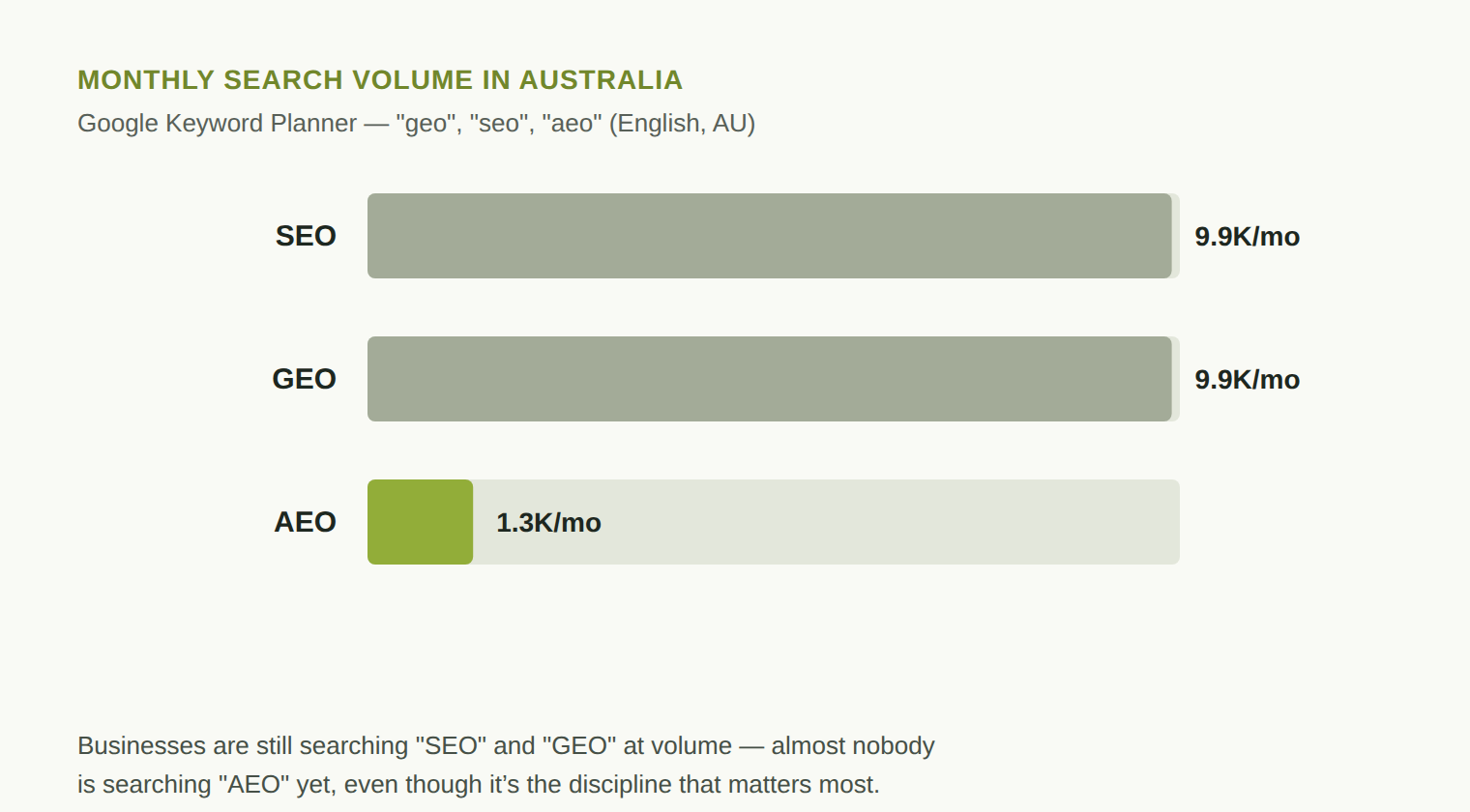
Client feedback and Google search volume both show that small businesses in Australia still have a poor understanding of what AEO actually is in 2026 - but most of our team expect that by 2027, every SME owner in Australia will know the acronym.
Which local business owners in Australia lost traffic after AI Overviews rolled out?
If you’ve been following this trend, you’ll know AI Overviews have mostly hit news, lifestyle blogs, how-to guides - content that’s easy to skim without a click. Pretty simple.
But what about the websites of local businesses in Australia? A bit more complicated.
Here’s the most dramatic decline we saw for one client, in July 2025:
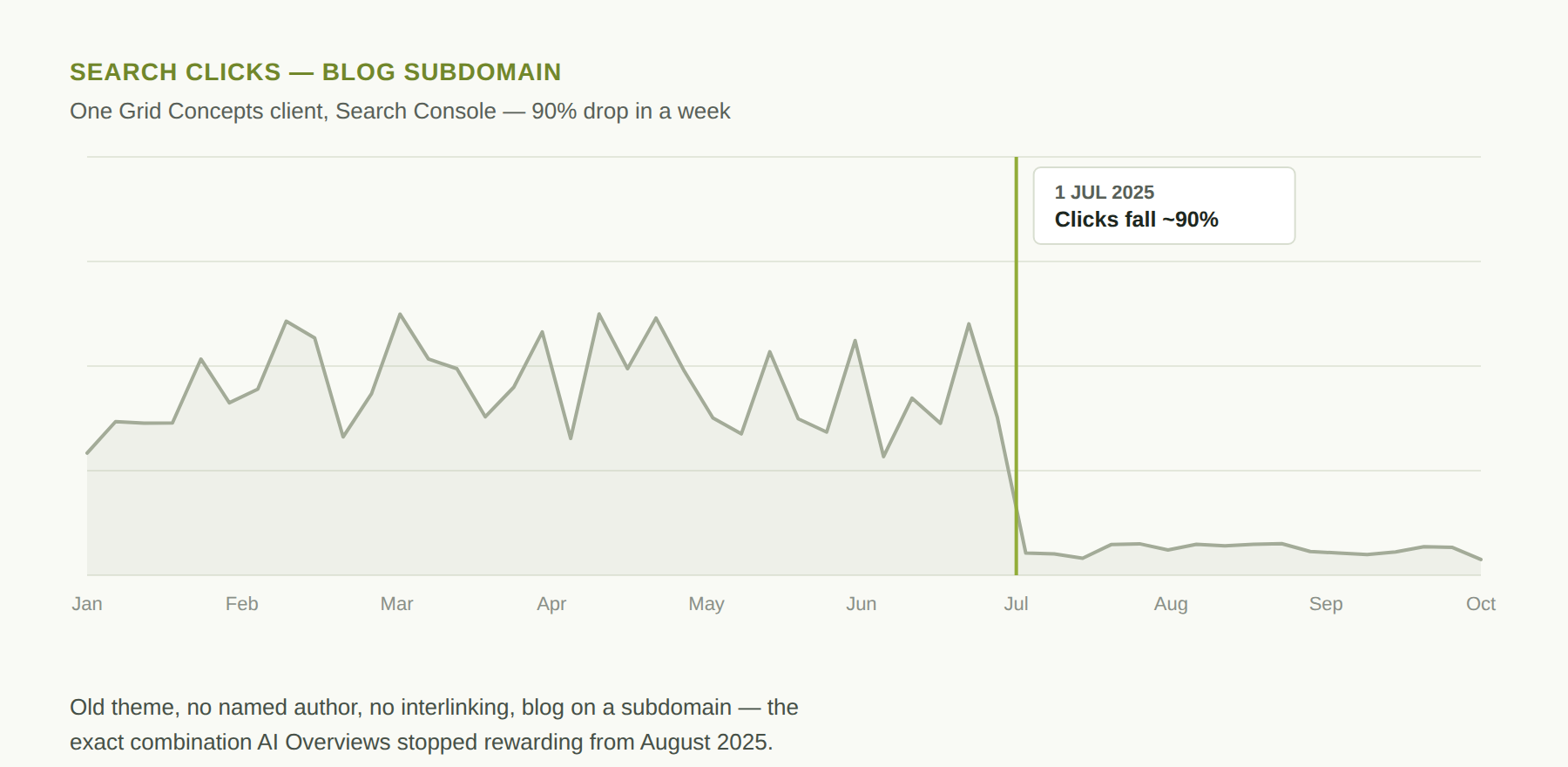
In one week, traffic dropped by 90%. Blog content essentially stopped ranking. I won’t list every measure we took - just the main findings on why it dropped:
- The website was old and had a poor mobile version.
- The author wasn’t listed on the website.
- The blog had poor internal structure (no interlinking, no “recent posts” section, and so on).
- The blog section sat on a subdomain.
Simply put, it was an old website, built back in the 2010s, and the client had been putting off updating it. We saw similar situations reported widely on forums in August–September 2025. Even clients holding top-3 rankings couldn’t break into AI Overviews without a named author and a properly structured blog.
In short, Google didn’t just implement AI Overviews - it also tightened its SEO criteria. More precisely, Google made trends from the last 5–10 years matter a lot more, specifically:
- Mobile-first
- Featured Snippets
- E-E-A-T
Since August–September 2025, these have become exponentially more important.
E-E-A-T, for example, covers authorship transparency in content creation - proof of the content creator’s authority and expertise. This is largely what hurt the site in the example above. The concept has existed since 2022, but its weight has increased sharply since August 2025. Australian clients with strong E-E-A-T signals were unaffected, while clients with weak E-E-A-T saw rankings drop.
E-E-A-T sounds simple, but in practice it covers things like:
- An “About Us” and “Terms & Conditions” section on the website.
- A real physical address shown on the website.
- Transparency of expertise - real photos and a real, named author for blog posts, with a linked social profile.
- A public profile for the business owner.
- Reviews on Google Maps.
- A high-quality backlink profile.
- At least 70 out of 100 on pagespeed.web.dev, for both desktop and mobile.
In my eight years in SEO, across roughly 30 mostly-Australian websites, I’ve never seen every one of those boxes ticked at once. If you think you’re producing quality content but still losing traffic, work through that list - you’ve almost certainly missed something.
Which local business owners in Australia saw traffic increase after AI Overviews?
All of our clients with strong service pages saw traffic hold or keep growing, and keyword rankings improved sharply. Take the same client from the 90%-drop example above - here’s the same period on their main domain, essentially a list of service pages:
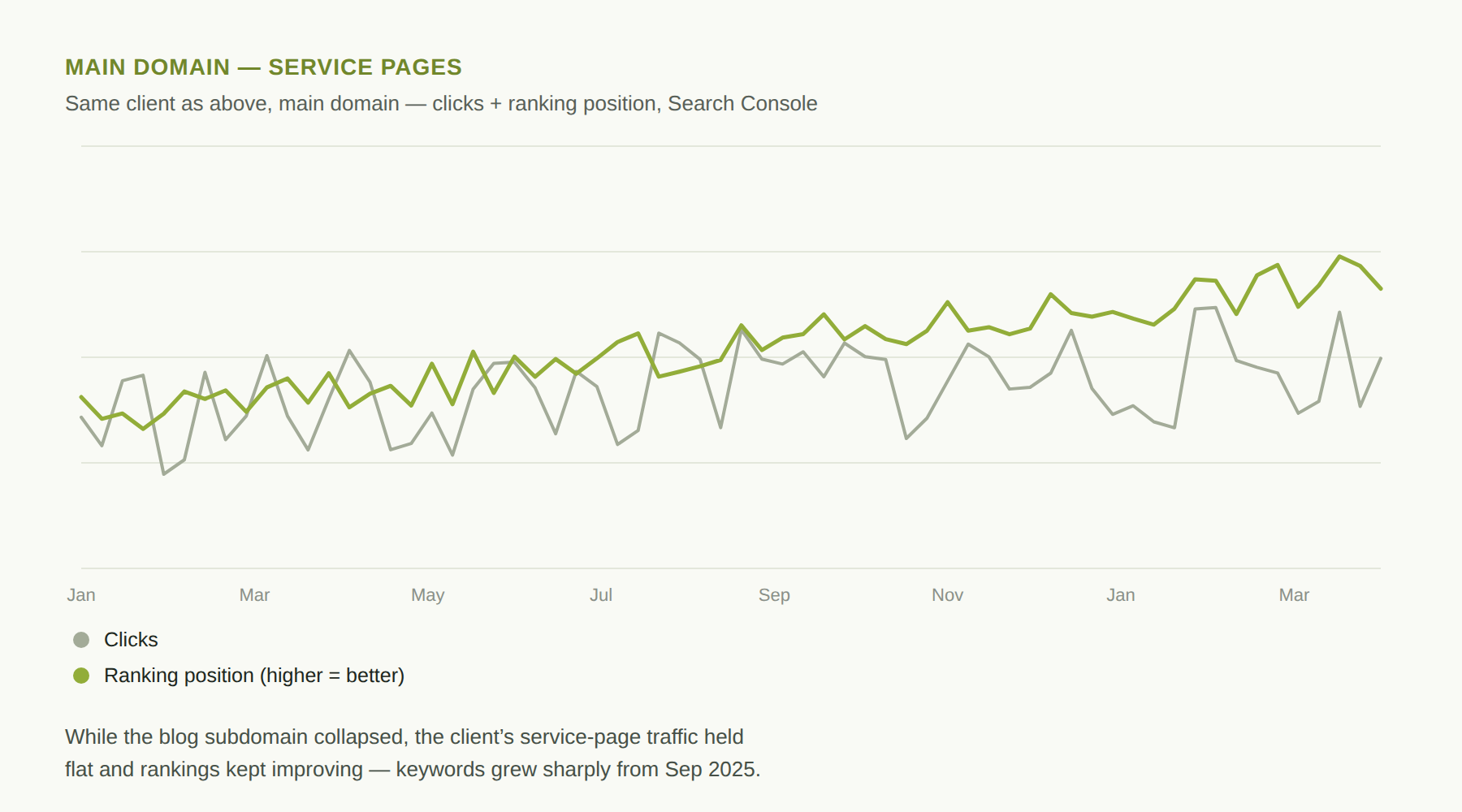
Traffic stayed flat while ranked keywords increased sharply from September 2025.
Many business owners in Australia believe the traffic drop hit almost every website, but that’s not the case. Here’s a short video walking through GA4 and Search Console data for two clients where AI Overviews actually improved traffic:
This is a common pattern across our client base, and it’s another signal for business owners: it’s time to review your service pages and get them as strong as possible.
What actually works for AEO when promoting a local business?
Now let’s get into how AI-era SEO actually works. We’ll break this into three steps. Each one matters, but each subsequent step gets more specialised and moves further from standard SEO toward AEO specifically.
Step 1: get the SEO basics right - because they also drive AEO
- Write proper meta tags.
- Check Google isn’t overriding your meta tags (if Google thinks a meta tag doesn’t match the page, it rewrites it).
- Meta tags need to be 100% unique.
- Content needs to be 100% unique.
- Check your breadcrumbs.
- pagespeed.web.dev should show at least 60–70 out of 100 on both mobile and desktop.
- Search Console should be error-free.
- Sitemap and robots.txt should be in order.
Step 2: layer in basic AEO
- Add FAQ sections - this has become more important in 2026.
- Do intent analysis: think through the actual questions a user would ask an AI assistant, and answer them directly in the FAQ.
- Find the Featured Snippets already ranking on your topic, and answer those questions too.
- Add proper markup for the FAQ section - AI systems favour it.
- Make the first two sentences of each FAQ answer a complete, standalone answer to the question.
- Spend more time on internal linking. Even a site with five articles usually has terms that carry across all of them - link them the way a Wikipedia editor would link related terms in an encyclopedia entry.
- Keep the
dateModifiedfield in your schema markup current. The page genuinely needs to be up to date, not just marked as such.
Step 3: advanced AEO
Serious AEO promotion usually needs cross-linking beyond your own site.
For example, if you sell robotic vacuum cleaners in Brisbane and post about your product on Reddit and Quora, you’re more likely to get picked up by ChatGPT and AI Overviews.
In plain terms, advanced AEO is about link authority.
And if you’re an SEO specialist, I know what you’re thinking: why not just buy a few backlinks? Because AI systems don’t treat backlinks the way search engines used to - they favour reliable sources.
That also answers how backlink strategy has shifted between 2025 and 2026: AI systems lean more heavily on data from Wikipedia, Quora, Reddit, rating aggregators, Google Maps and review sites. The more a business owner cares about GEO and AEO, the more attention this deserves.
Our team’s experience is that you’re more likely to show up in AI results with 10+ reviews on Google Maps than with 10+ purchased high-authority backlinks - a clear signal that in 2026, it’s better to put resources into Google Maps reviews than into buying backlinks.
What types of articles perform better after AI Overviews?
The guide above matters less if you run an informational site, so it’s worth a separate look. Blog content comes in different types - guides, interactive pieces, evergreens and so on. What’s changed since AI Overviews rolled out?
Almost all “evergreen” article formats stopped performing as well:
- Top 10 articles
- How-to articles
- Ultimate guide articles
These held up or improved:
- React content - an expert reacting to a news item relevant to their business.
- Living content - for example, articles with interest-rate forecasts, updated once or twice a month as news develops.
- Cornerstone content - the main, fundamental article a content cluster is built around.
- Freshness-driven content - content maintained with regular, genuine updates.
Here’s the content-type split for one Australian client’s information portal:
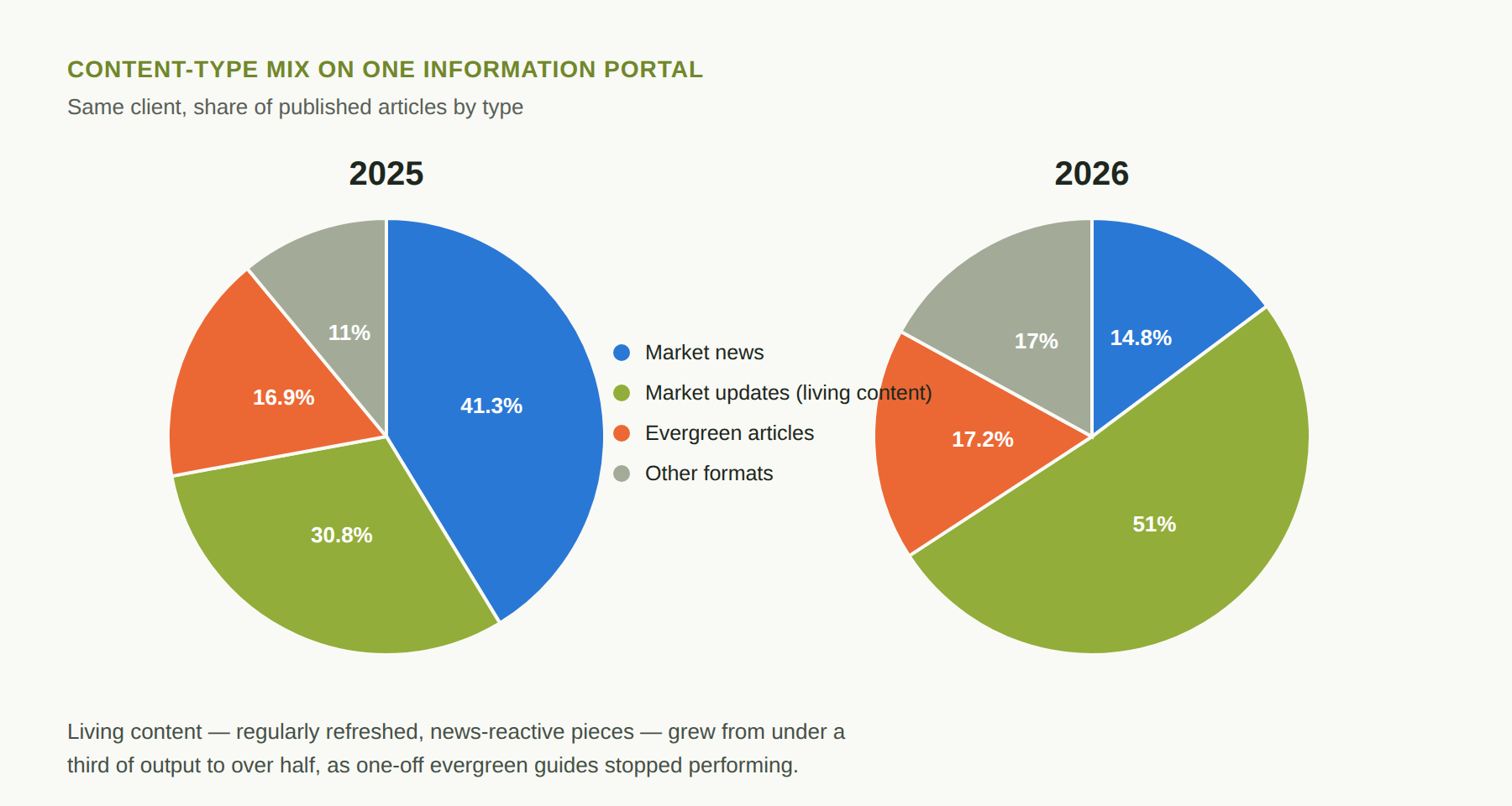
Living content became significantly more popular - though this chart doesn’t capture the extra effort now required just to keep evergreen content holding its position.
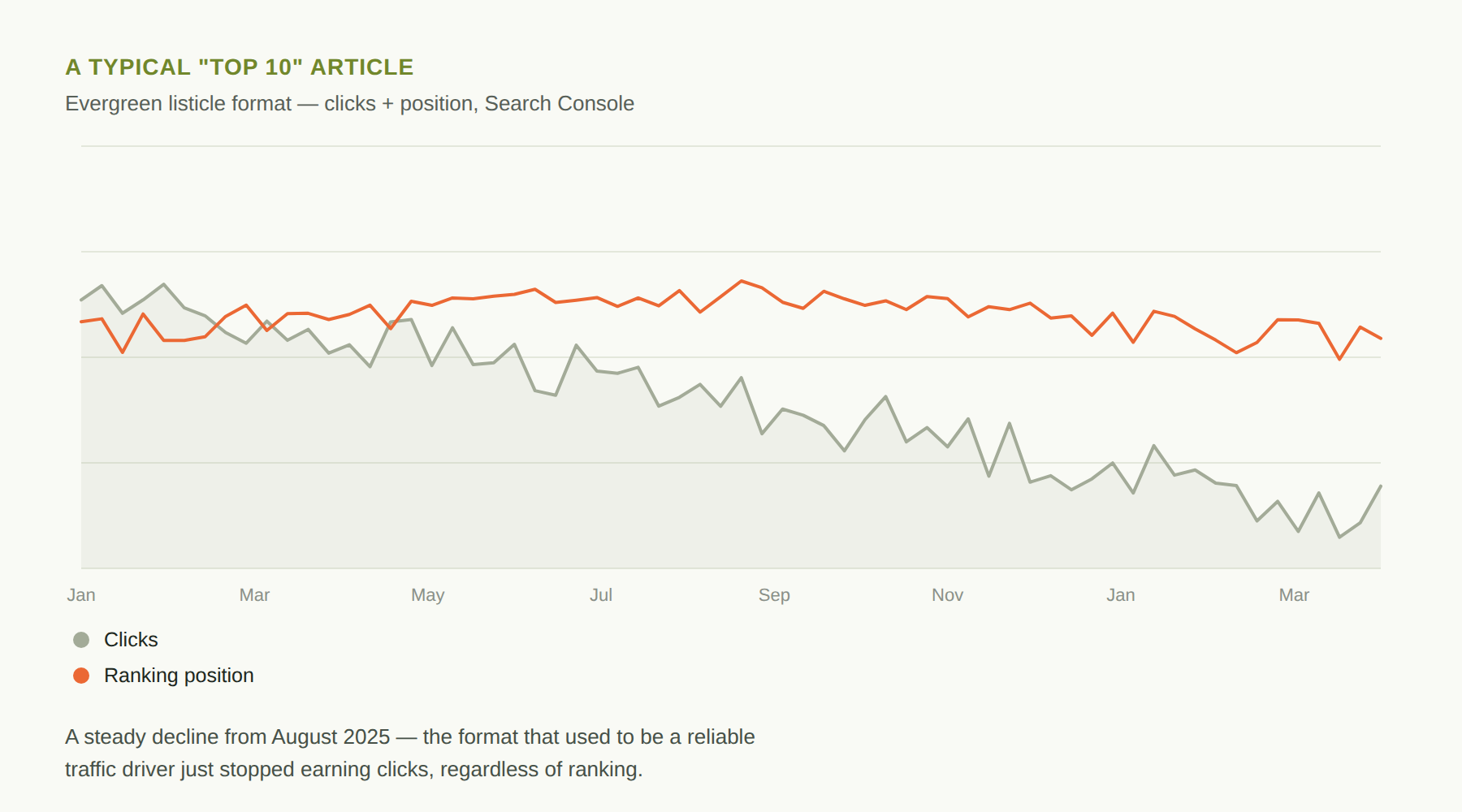
Here’s what a typical “Top 10” article’s decline looked like after August 2025:
And here’s what a Living Content article looked like for the same client after July 2025:
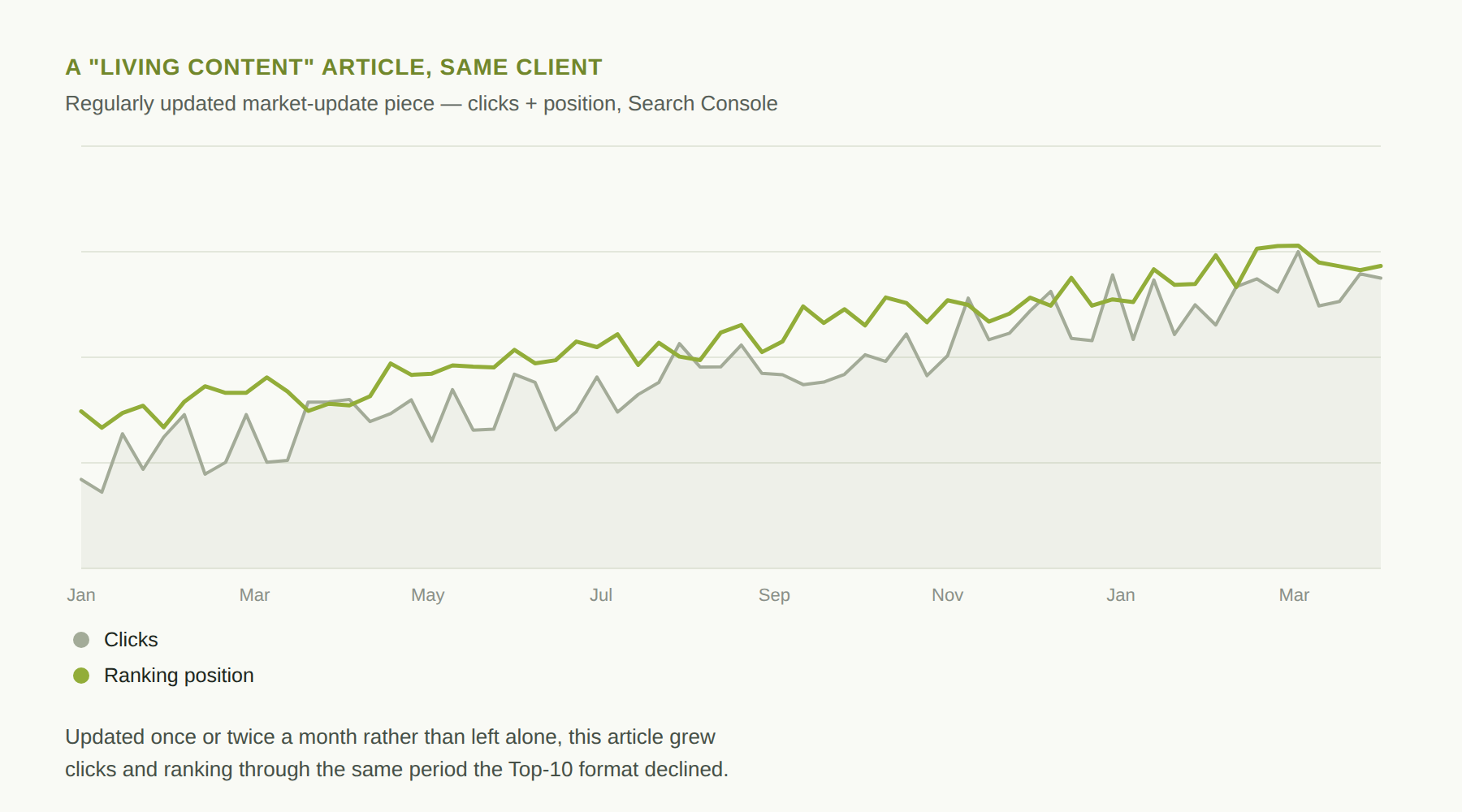
As the charts show, the shift in what works for blog content happened quite suddenly, in August–September 2025.
How have traffic sources on Australian websites changed since AI Overviews?
It’s not just article type that changed - traffic sources shifted too. In summary:
- Traffic has deglobalised.
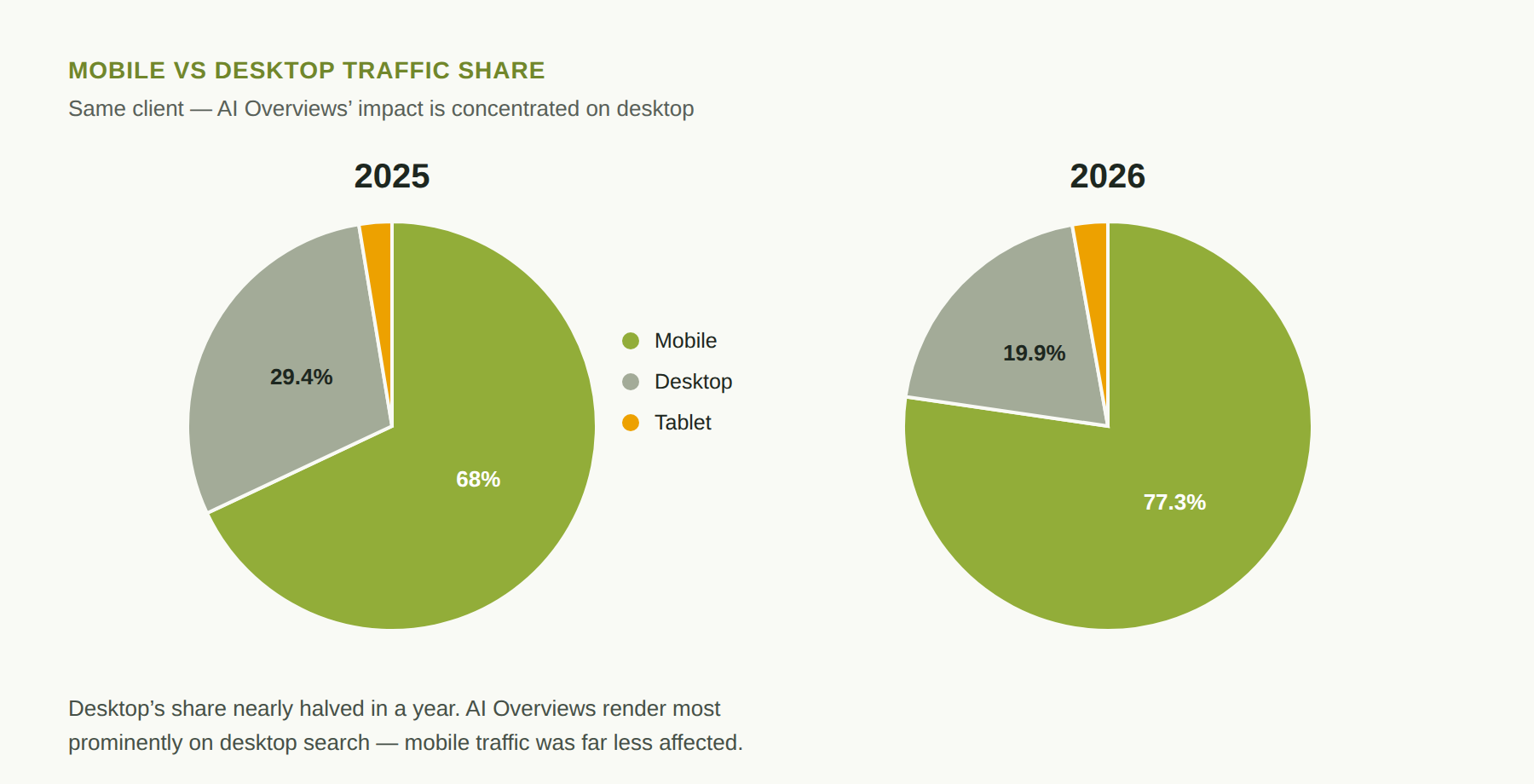
- Mobile traffic’s share has grown.
- Desktop traffic’s share has declined (no surprises there).
- Traffic has become less keyword-driven and more source-driven - a known trait of Discovery-style traffic.
- News traffic’s share has increased - likely for the same reason: a good news source lives more on platform authority and less on keyword ranking.
Here’s the traffic split for one client comparing January–May 2025 with January–May 2026:
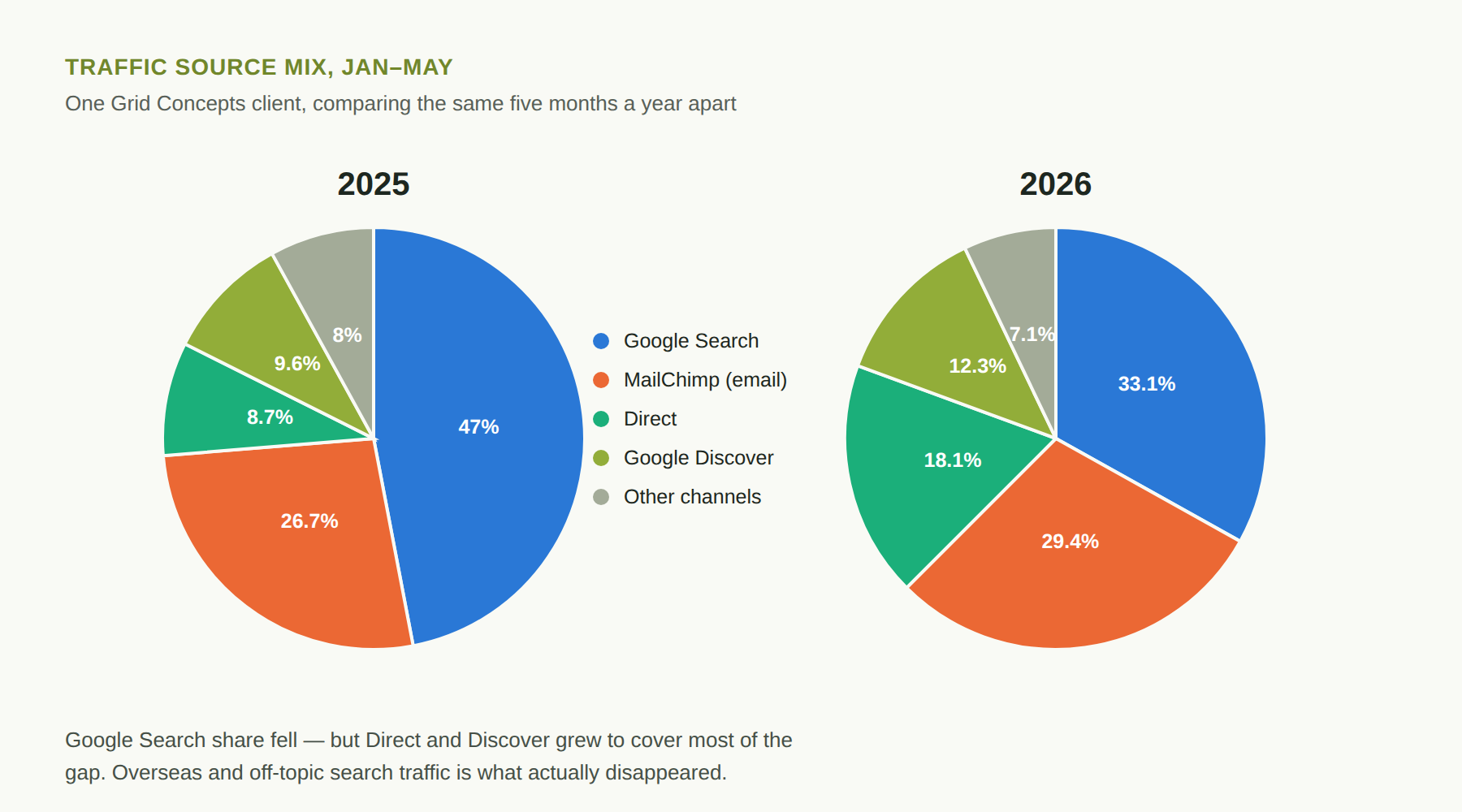
We lost roughly 20% of Google Search traffic (no great shock there), but the interesting part is that local traffic only dropped by 13%, and almost all of that decline came from one of Australia’s three largest cities. In other words, we’re getting roughly the same number of users from nearly every other Australian city as before.
Not quite as alarming as a lot of the SEO commentary made it sound last year.
As we’ve already touched on with other client examples, the traffic decline widely reported through 2025–2026 as an “AI trend” is mostly a matter of Google eliminating irrelevant traffic and tightening the bar on demonstrated local presence.
In plain terms: fewer overseas visitors, and less traffic showing up in cities the business doesn’t actually serve.
One more finding worth flagging: AI Overviews’ negative impact is concentrated on desktop traffic. Fairly obvious once you say it, but analytics tools don’t often call it out - AI Overviews perform strongest on desktop.
Meanwhile, Google Discover’s share - where a user isn’t actively searching but gets served a recommendation - increased by roughly 30%.
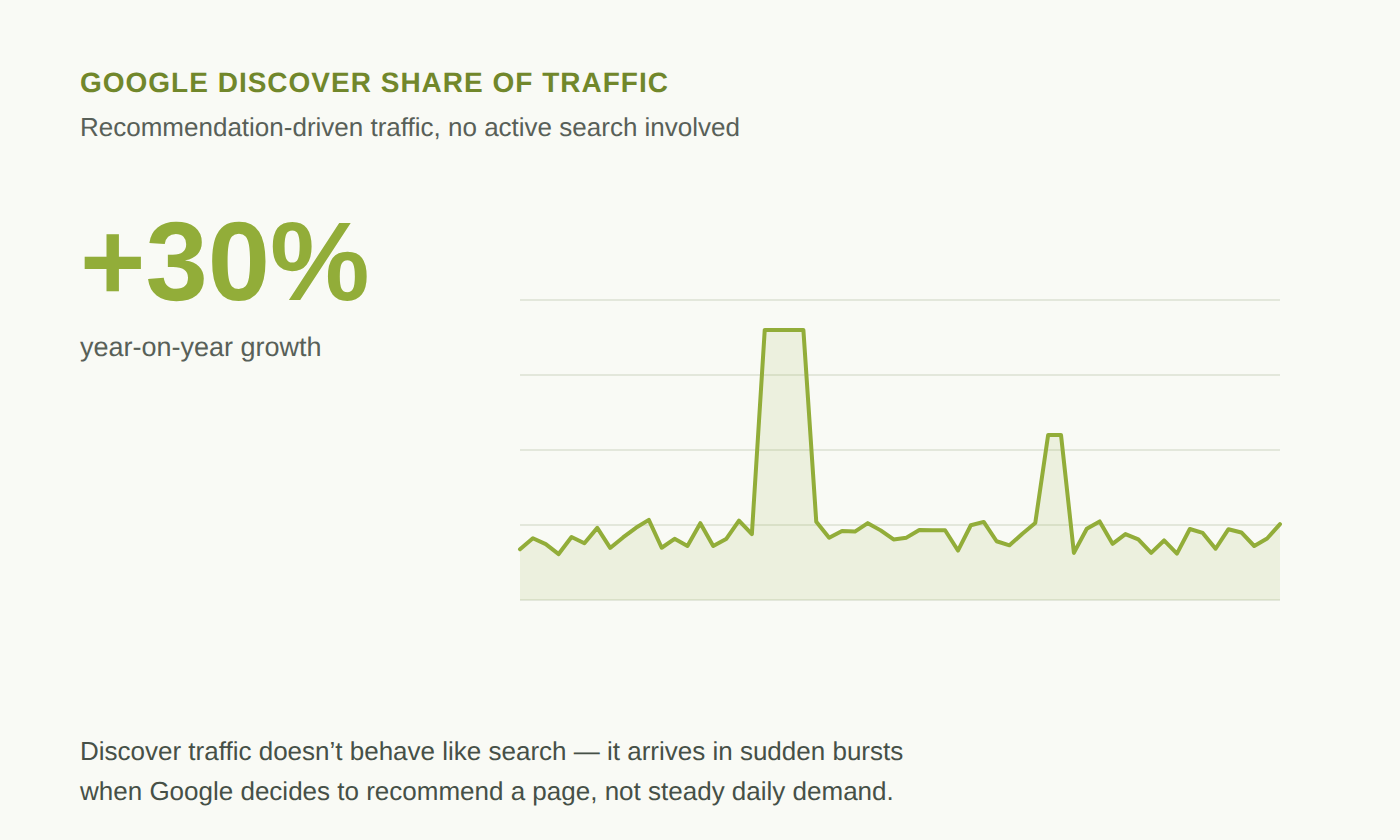
Google News’ share of traffic has also grown noticeably compared with 2025, even though the charts above don’t capture that on their own.
Overall, traffic has become more tied to current events, and competition for freshness and relevance has increased. SEO now behaves more like a fast-moving river - the advantage goes to whoever moves competently, quickly and confidently.
SEO vs. GEO - which should you actually choose?
Based on everything above, the short answer is: back SEO. GEO only makes sense as a separate line item once AI sources are already sending you real leads, and you can see positive movement for that traffic type in GA4.
Our clients’ data shows AI sources deliver no leads at all in roughly 9 out of 10 cases - for now.
Is it worth adding llms.txt to a website in 2026?
I wouldn’t rush into it.
We haven’t seen a client install llms.txt and see any measurable change from it. Neither OpenAI nor Google has confirmed support for it, so there’s no guarantee it does anything yet. At the same time, our data suggests that within a year or two, something will genuinely need to be done about the volume of AI bots hitting client websites.
Here’s an example. In December 2025, our team was genuinely surprised when bot traffic share for several clients jumped from the usual ~10% baseline to around 50% - almost all of it AI crawlers. There was so much of it that it briefly looked like a DDoS. It turned out to be widespread - by early 2026 the whole SEO industry was talking about the jump in bot traffic.
Here’s a short video walking through GA4 and Search Console data for two clients, showing the correlation between the spike in bot traffic and a subsequent drop in Search Console impressions:
If you work in SEO, you’ll understand how surprising this data was to us.
Both affected sites get 5,000–7,000 monthly visits - one serves a Brisbane audience, the other Melbourne - and both started seeing heavy bot traffic from overseas at almost the same time.
What does this mean? The idea behind llms.txt is to set clear rules of engagement between AI systems and site owners. The data above shows those rules don’t really exist yet. Site owners are currently left dealing with surprises like the one above.
Nobody enjoys surprises - everyone wants clear rules. Does llms.txt make things more predictable right now? No. Might it help eventually? We’re hopeful.
GEO wants short answers to questions - isn’t that just Featured Snippets?
Most AI guides tell you to imagine the questions users will ask a neural network. But tailoring text into short, clear answers is exactly what SEO specialists were already doing 5–10 years ago for Featured Snippets. Aren’t they the same thing?
There’s real overlap. But there’s a clear difference too.
If a user asks “how do I fix a vacuum cleaner,” that’s clearly a Featured Snippet question. If they ask “why does my dog keep chasing the robot vacuum,” that’s definitely not a Featured Snippet - but it could still be genuinely useful content if you sell vacuum cleaners. See the difference?
Here’s a more abstract but maybe clearer way to put it. If you’ve worked in SEO, you’ve likely hit queries so narrow that the only results are forum threads on somewhere like Reddit. Forum links are always awkward, because a tool like Ahrefs can’t reliably pull keyword data from them - so there’s a link but no measurable keyword. The gap between GEO-style queries and Featured Snippets is a lot like the gap between the questions you’d see in Google and the questions you’d see on a forum.
If you’ve ever done copywriting, you’ll know forums are a genuinely useful source when you’re building out real depth on a topic - a deeper, older layer of the internet, closer to how it worked back in the ’90s. In a sense, neural networks are trying to capture exactly that layer of information.
Should you avoid AI Overview-heavy keywords when planning content?
Today the answer is clear: no - you should check the relevant AI Overviews and write content in a way that gives Google a reason to cite you as an additional source.
But this became one of the most debated topics on our team through 2025 when it comes to blogging.
Picture the situation: you’re building a content plan, but the keywords on the table can’t realistically break the top 10 because of a domain-authority gap between your client and their competitors. That used to be less of a problem - a top-15 ranking still delivered decent traffic. Today, if you’re not in the top 10, you’re not in AI Overviews. So every SEO specialist ends up asking the same question: wouldn’t it be easier to write about narrower topics where an AI Overview isn’t triggered at all?
One approach that’s worked for us: drop the pure evergreen strategy, and focus instead on answering the most current, pressing questions in a client’s niche - the “living content” approach covered above.
Is it true AI Overviews ignore pages that rank #1?
If you work in SEO, you’ve probably noticed articles ranking in the top 3 that AI Overviews still skip in favour of citing lower-ranked pages. It looks like a deliberate move from Google to offset the decline in clicks on the very top organic result, which was widely reported through 2025.
We’ve seen this with our own clients too, but I wouldn’t build a conspiracy theory around it. Good structure matters for SEO; authority matters for GEO. If you have excellent content but a competitor carries more authority (see E-E-A-T above), you can end up with the odd-looking result where a page ranks #1 organically, but AI Overviews cites a page from further down instead.
Does updated content rank better in AI Overviews than older content?
No - it works the same as standard SEO. If you built a genuinely useful page and the information is still accurate five years later, you won’t lose rankings just because it’s old; Google doesn’t favour newer content over older content by default.
People ask this because so many sites saw sharp declines after AI Overviews rolled out. But if a site has been technically sound and followed good SEO practice for the past decade, its older posts should perform at least as well in AI Overviews as newer ones.
How much does adding an FAQ actually help with AI Overviews?
Everywhere you look, people say FAQs are hugely important for GEO. I’d say the feature is less important than the hype suggests.
We have two comparable local clients. Both have strong Google Maps reviews. Both have service pages ranking in the top 10. The client without an FAQ section got picked up in AI Overviews; the one with an FAQ didn’t.
The difference is competitive density: the first client operates in a niche with only a handful of competitors, while the second is in a niche with hundreds.
FAQs have become more important than they used to be - but they’re not more important than your link profile or your Google Maps ranking.
Does using AI tools actually help us win more for our clients?
In 2020, copy was written by hand. In 2026, a lot of it is drafted by neural networks. In 2020, designers built separate static images for Google Ads and Facebook Ads; now producing video is comparatively easy. Has that translated into higher profits for clients? More accurately, it’s helped us hold our metrics steady - particularly on video production, where output has grown enormously compared with 2025.
Overall, using AI tools isn’t some kind of cheat code - it’s closer to table stakes. Everyone’s using them, so if you want to hold your position, you need to as well.
Somewhat paradoxically, we’ve also seen cases where a batch of AI-generated video, backed by a $3,000–$5,000 Google Ads budget, produced fewer leads than traditional static images. But we’ve also seen the reverse - where several rounds of manual rewriting plus a well-built prompt pushed an article into the top 5.
Has AI made things easier? Yes. But the time it frees up gets reinvested into higher-quality SEO, just to hold the results we were getting three or four years ago.
What that means in practice: our expertise is now in higher demand, not lower. Where a client might once have said “I’ll write this myself and get the traffic” - and actually succeeded - that’s changed. A client might not even write the article anymore (ChatGPT will do that part), but without proper SEO underneath it, that article won’t get any traffic at all.
At the same time, the shift above has brought real churn into SEO, and it’s made clients more cautious about where they spend (along with Australian interest rates, to be fair).
If any of this sounds familiar, our free AI-Readiness Data Check is a straightforward way to see where your own website and data stand before you spend more on either SEO or GEO - no sales call required to get the result.