Choosing the best AI for text generation in 2026 (comparative test)
By Anton Sednin, Grid Concepts
Which neural network (AI) is best suited for text creation if you are an SEO specialist, a marketer, a copywriter, an SMM specialist or a content manager?
At the start of 2025 we already ran a test like this, and back then the undisputed leader was ChatGPT. Lately, though, the IT community has voiced a lot of complaints about ChatGPT, so we gathered together all the AI text generation tools the GC team uses and worked out which AI actually produces the best text in 2026.
The topics we will cover in this article:
- Which AI is best for text generation in 2026?
- Common problems with AI when generating text today.
- Has ChatGPT become worse at generating text, and is it time to retire this AI?
How did the test work?
For this test we compared 5 neural networks used specifically inside Grid Concepts. Here they are, sorted by how frequently GC team members rely on them:
- ChatGPT
- Claude
- Gemini
- Copilot
- DeepSeek
All of the tests (except DeepSeek) were run in the paid version of each AI and in a New Chat. It is also important to note that all accounts (except DeepSeek) are used on a permanent basis, which matters given that many users have noticed that newer accounts tend to generate higher-quality content.
We wrote one identical prompt that we fed to every neural network. That prompt included the following tasks:
- Write text from scratch, 7k characters
- Analyse a client page and parse the data from it
- Build a table
- Insert native hyperlinks
- Insert keywords
- Produce meta tags
Which AI is best for text generation in 2026?
Here are the final results of the test:
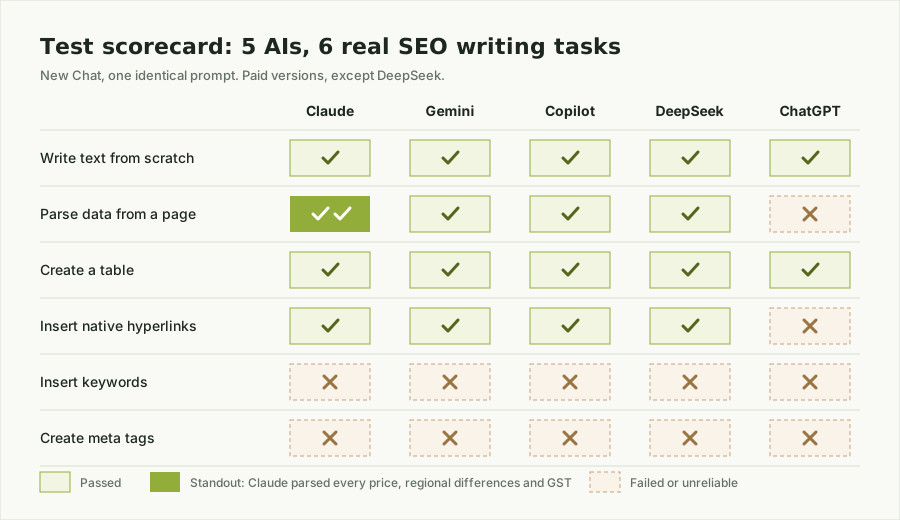
Based on these results, Claude won by a significant margin. That is especially telling given how weak this AI looked in the equivalent comparative test a year ago.
Here is the list of these text generation AI systems, sorted from best to worst:
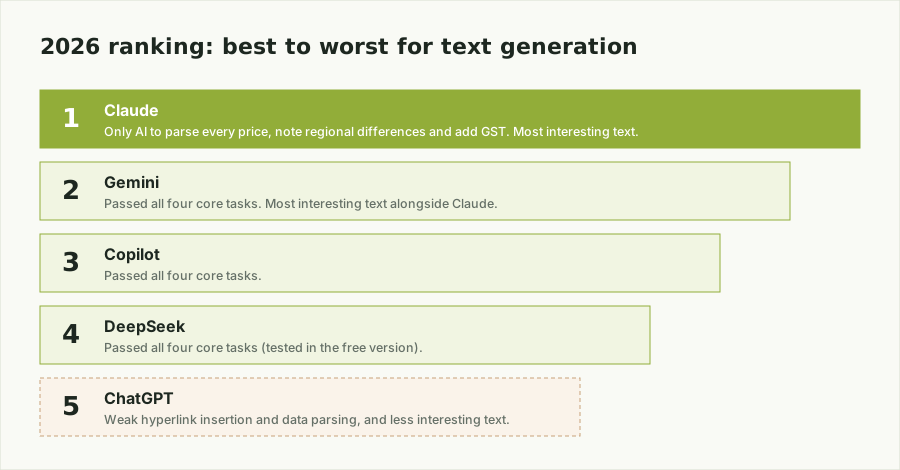
And yes, ChatGPT came out worst of all. I suspect anyone who looks at this ranking will ask: how could that happen? There were three reasons.
- Poor quality of hyperlink insertion. The task was to write an article for a client and, seemingly in passing, drop in links to that client’s service pages. I repeated this test in both the paid and the free version of ChatGPT, across three different accounts and with several variations of the prompt. Every single time the result was unsatisfactory.
- Poor data parsing. Part of the task involved parsing prices from the client’s service page and inserting them into several sections of the article. While ChatGPT barely coped with this task, Claude turned out to be the only AI that not only parsed all the prices but also clarified how the price differed by region, as well as the need for an additional GST payment.
- Poor quality of text. Claude and Gemini also generated the most interesting text. That metric is subjective, though, which is why it is mentioned last.
A separate, unpleasant detail is that ChatGPT has the most trouble with a small thing like the em dash. By default ChatGPT inserts it with no spaces around it, while Copilot uses (clarification: during our test, your experience may be different) a hyphen instead. Claude, unlike both, has no such issues. It is too minor a nuance to include in the scorecard above, but it is these small things that build up into a broadly negative attitude toward the service.
Overall conclusion: over the past year ChatGPT has not only fallen significantly behind its competitors but subjectively feels worse than it did a year ago. How could this happen? I do not think it is only that this particular AI got worse (we will discuss that below). This is my personal opinion, but I think I was simply using ChatGPT too much as a content creator. If you are using AI professionally, it is best not to limit yourself to just one AI (even for something as simple as creating text content) but to have several trained AIs and use them in parallel from time to time.
Which tasks did the AI handle worst in text creation?
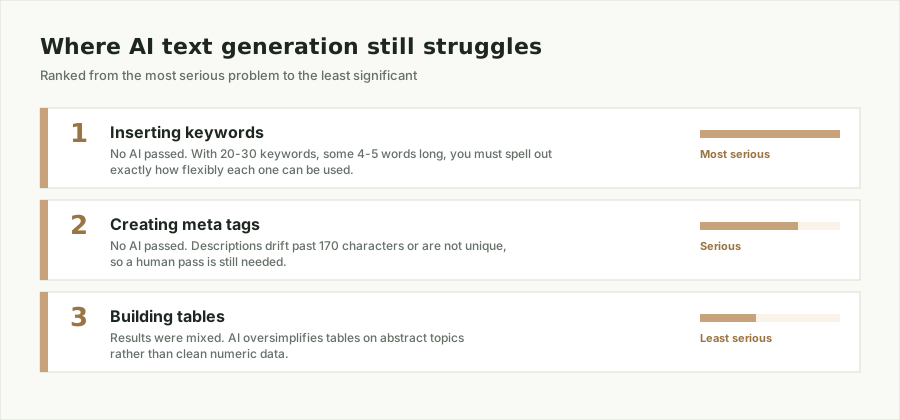
In my practice, neural networks usually run into problems with three tasks. Here they are, from the most serious to the least significant:
1. Inserting keywords
The AI tools do not work well enough with keywords. This is now the third year our GC team has been using AI text generators for content creation, and every one of them still has problems inserting keywords natively. Every time, it is not enough to simply list the keywords in the prompt - you also have to specify very precisely how flexible their implementation should be. This is a recurring headache for anyone doing professional SEO work.
It is easy when you have 5 keywords and 5,000 words of text. But imagine you have 20-30 keywords (some of which are 4-5 words long) that need to be evenly distributed throughout the text and natively inserted in the right sections.
Each time, I have to write a detailed prompt. Why does AI hate me so much? It is hard to imagine why I need to tell it not to insert multiple keywords into one sentence, use capital letters, or break the word order. But any AI is just waiting for me to be too lazy to specify something like this in the prompt.
I know some will say this is not their experience. But I assure you, if you produce 20-30 articles a month, you will likely say otherwise.
2. Creating meta tags
The situation with meta tags is similar. Even if you write “produce a title and description to Google’s SEO standards” in the prompt, almost every AI will at some point hand you a description longer than 170 characters, or the text will turn out not to be unique. Reliable SEO writing still demands a human pass over that output.
3. Building tables
AI also loves to oversimplify tables. The problem is especially relevant when you are dealing not with easily categorised numeric data but with more abstract topics - for example, if you ask an AI to compare the behavioural pattern of a scammer’s phone call against that of a real estate agent.
In the end, none of the tested AI passed the meta tag and keyword test, and the table generation tests produced mixed results (worse in some places, better in others).
But three years ago, AI handled these tasks far worse, so I think that with each passing year these issues will become less and less noticeable, which is good news for anyone who wants the best AI for SEO writing.
Why did ChatGPT get worse at generating text in 2026?
In short, ChatGPT has reoriented itself away from text creation and toward coaching and general advising. According to OpenAI, these types of requests account for 49% of all queries in ChatGPT.
We are not the first to notice ChatGPT’s decline in 2026. In the first half of the year, articles started popping up here and there arguing that ChatGPT had gotten worse at working with text.
This coincided with the free version of ChatGPT removing the ability to choose which type of model to use (you used to be able to pick between “smarter” and “dumber” versions). Before running the tests, we assumed this was exactly the cause - that if we selected maximum output quality in the paid version, we would get the same text ChatGPT used to produce. But, as the results above show, we were wrong.
Why did this happen? The common belief is that the switch from the GPT-4 model to GPT-5.x is to blame. But that is only a formal explanation. If you turn to OpenAI’s own statistics, it turns out that text generation ranks only third among the tasks people usually perform with ChatGPT. If you sort the AI systems we tested by the tasks they are used for most often, you get the following picture:
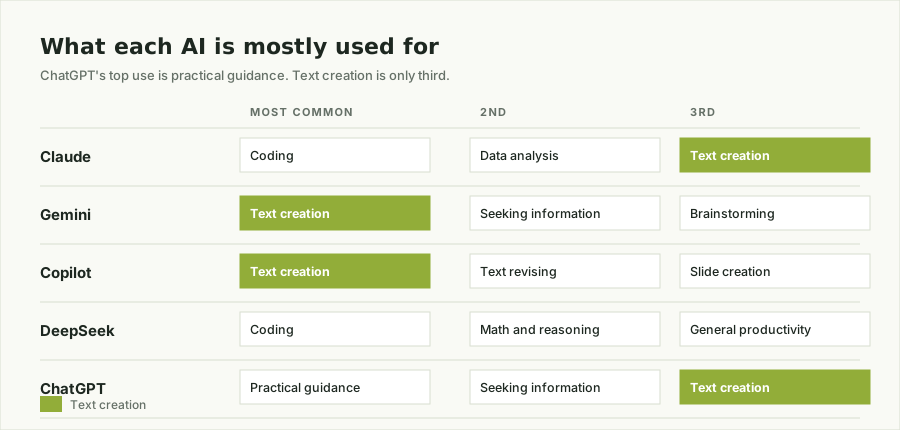
From this, the natural conclusion is that ChatGPT moved from GPT-4 to GPT-5.x in order to better serve its target audience. It seems ChatGPT wants to become the leading AI for practical guidance, because it is impossible to be a perfect AI that handles every type of task well at once.
It is also worth mentioning the rumours that the drop in ChatGPT quality is tied to its growing popularity. ChatGPT has a bigger audience than all the other AI tools combined, and every request is a load on the server. It is possible that in 2026 OpenAI applied the classic marketing strategy of beer producers: first release a quality drink, then, once it becomes a mass-market product, lower the quality.
Either way, all that matters is the final result.
Do plugins in ChatGPT give an advantage when generating text?
That depends on the test. While ChatGPT’s plugins do set this AI apart from the rest in general, it is clear the market is moving not so much toward plugins as toward using separate, specialised AI for specific tasks. As part of the testing we additionally ran several tests with plugins for text creation, but we still did not get satisfactory results.
That said, the prompt we wrote assumes a multi-level task, and this test reflects the needs of our marketing agency. If a business owner simply needs to write an SEO text, then perhaps a plugin from ChatGPT will still perform better than Claude for basic SEO-friendly content generation.
What this means for your content workflow
If your day revolves around blogging, creating posts and shipping steady SEO content, the takeaway from our 2026 AI ranking for text generation is straightforward: pick the right AI for the right job rather than expecting one model to do everything. The second conclusion: use several neural networks in parallel, if you have the opportunity.
For long-form drafting, the best AI for blog writing in our test was Claude, with Gemini close behind - both proved to be dependable for SEO content when guided by a careful prompt.
Anyone searching for the best AI for text creation should treat these tools as a strong first-draft engine, not a finished product. A good AI SEO content generator will accelerate research and structure, but human editing still decides whether the content ranks. The same holds for any AI SEO writing task: the model handles volume, and you handle nuance, tone and accuracy. That balance is what turns a raw AI draft into publishable SEO content, and it is why our team keeps refining its process year after year.
If you want help working out where AI fits in your own content and marketing workflow, our complimentary AI-Readiness Data Check takes about ten minutes and gives you a plain picture of where to start.