
AI for real estate agents: open-home follow-ups and vendor reporting
Short answer: AI for real estate agents earns its keep in two jobs: turning an open home’s sign-in sheet into a same-day follow-up instead of a cold message two or three days later, and pulling portal views, enquiries and attendance into the weekly vendor report automatically instead of compiling it by hand from three different logins. It will not decide which buyer is serious, write your price strategy, or replace the phone call to the vendor. Pick whichever of the two is costing you more hours right now and start there.
If you are running a sales desk, “open-home follow-ups and vendor reporting” is not an abstract productivity problem - it is the two jobs that eat Saturday afternoon and Monday morning, every single week. AI for real estate agents gets pitched as a blanket fix for “client engagement”, but strip the marketing away and there are really only two tasks worth automating first: turning the people who walked through an open home into a same-day follow-up, and turning the week’s portal numbers into a vendor report without logging into three different systems to build it.
Why do open homes and vendor reports eat so much of an agent’s week?
Three things are pulling in the same direction at once: fewer people through each open home, longer campaigns, and vendors asking for more data, not less.
| Source | What it found |
|---|---|
| REIV, Cameron Kusher market commentary | Melbourne’s median days on market for a private sale reached 42 in June 2026, up from 39 a year earlier; regional Victoria sat at 51 days |
| Ray White chief economist commentary | National average open-home attendance fell to 2.1 people per inspection over four weeks to 11 July, down from 3.6 a year earlier - Sydney, Melbourne and Brisbane all now sit around two per open |
| Jobs and Skills Australia, ANZSCO 612114 (2021 Census) | Real estate agents average 46 hours a week full-time, against 44 hours for all occupations |
| Reapit, State of the Australian Real Estate Market 2026 (500+ agents and property managers surveyed) | 29.6% of landlords are now seeking direct access to data insights on their own investment |
| ABS | AI adoption among Australian businesses rose from around 1% (2021-22) to roughly 12% (2024-25) |
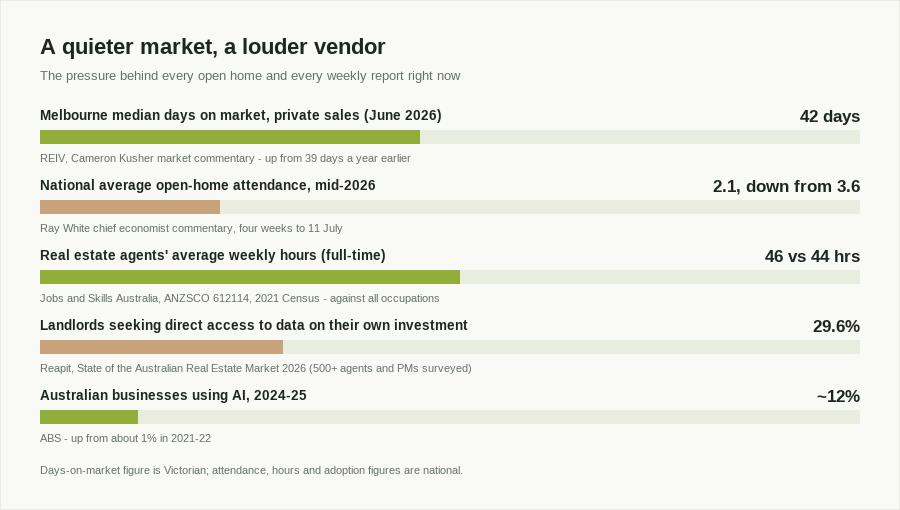
What that means for an agent: fewer people are walking through each open home, so a slow follow-up now loses one of a shrinking pool, not one of many. Campaigns are running longer, which gives a vendor more time to notice if your reporting goes quiet. And vendors are asking their agents for more direct access to data on their own investment, not less - better they hear that from you than read it in an industry survey.
Can AI actually follow up open home attendees for you?
Yes, for the capture and the first message. Not for the judgement call.
- It captures attendees digitally instead of on a clipboard. A QR code or tablet sign-in at the door, synced straight to the CRM the moment the open home ends - tools like Domain’s HomePass and Rex Mobile already do this as standard, so nobody has to retype a paper list back at the office that night.
- It drafts the same-day follow-up. A short message with the listing details, the next open time and an invitation to ask questions, sent the afternoon of the open home instead of whenever the list finally gets typed up.
- It flags the attendee worth a phone call. A repeat visitor, or someone who left a comment on the sign-in form, gets surfaced ahead of the general list - so the genuinely warm lead gets a call, not the same templated email as everyone else.
- It still needs you to judge who is serious. A name and a tick on a sign-in sheet tells you someone walked through the door. It does not tell you they are ready to make an offer - that call stays with you.
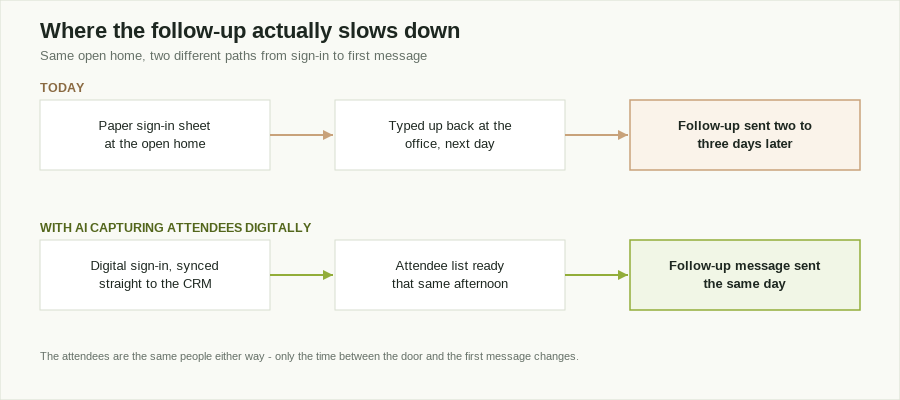
With national open-home attendance down to roughly two people per inspection, a follow-up that waits two or three days is not a small delay - on a quieter market, it is a meaningful share of everyone who showed interest that week.
Does AI actually write a better vendor report?
Partly, and it is worth being precise about which part.
| Job | What AI actually does | What still needs a person |
|---|---|---|
| Weekly campaign recap | Pulls portal views, enquiries and open-home attendance into the agency’s report template automatically | Deciding what the numbers mean for strategy - hold the price, add marketing, or re-list |
| Feedback summary | Drafts a plain-English summary from the agent’s open-home notes and sign-in comments | Judging which comments are worth passing on, and how to phrase a hard one |
| Next-step suggestion | Drafts a suggested next step from the pattern in the data - high views but low enquiries, a quiet weekend | The actual conversation with the vendor about price or timing |
| Sending it | Nothing changes about who owns the relationship | The vendor wants to hear it from you, not an auto-generated PDF that lands with no call |
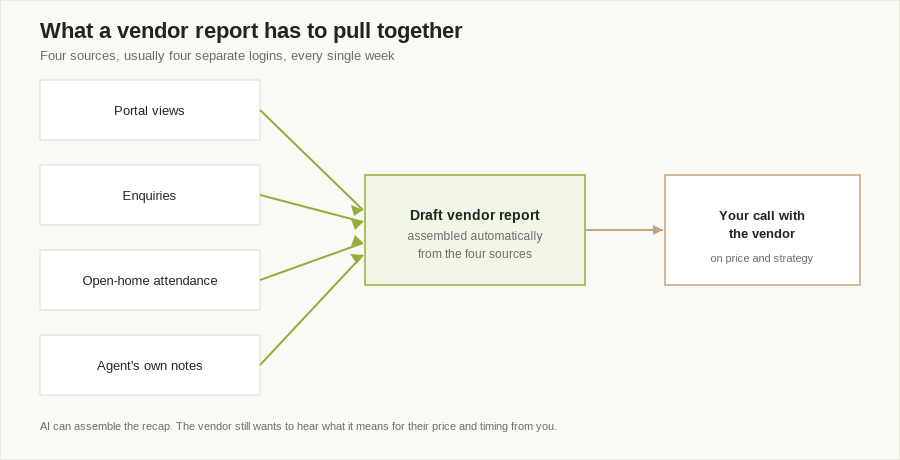
With close to three in ten landlords now wanting direct access to data on their own investment, the value here is not a prettier PDF - it is getting back the twenty minutes you would otherwise spend logging into the portal, the CRM and your own notes to build one, so you can spend that time actually having the price conversation instead of assembling the slide that precedes it.
Why does this work at one agency and not the next?
Almost always because the inputs are scattered. If portal leads land in a personal inbox, the open-home sign-in sheet is still paper, and vendor notes live in a notebook on the passenger seat, no report-writer and no follow-up tool has anything reliable to draw from - there is nothing for it to assemble. We cover this gap in more detail in Fix the data first - then AI works; it is the same pattern whether the business is an agency, a trade, or a professional practice.
The fix is not a smarter tool. It is deciding that attendee data, portal leads and vendor notes each live in one place, consistently, before anything automated goes near them. The same four-job pattern - the after-hours enquiry, the quote, the schedule, the admin chasing - turns up across other service businesses too, which we cover in AI agents for trades and field service businesses.
Where should an agent start with AI?
Pick whichever of the two jobs - follow-ups or vendor reports - is costing you more time right now, and start there, not both at once.
- If it is follow-ups: count how many of this week’s open-home attendees actually got a same-day message versus how many waited until you were back at a desk.
- If it is vendor reports: check whether your portal views, enquiries and attendance already live in one system, or whether Friday’s report means logging into three separate platforms to build it by hand.
- Either way, do not buy a whole-of-agency platform when the real cost is these two specific tasks. The broader the system, the longer it takes to see whether it actually fixed the thing that was slow.
Our complimentary AI-Readiness Data Check takes about ten minutes and tells you plainly whether your attendee and vendor data already sit in one place well enough to support an AI tool, or what needs fixing first - before you spend on anything.
Frequently asked questions
Can AI actually follow up open home attendees automatically?
It can capture attendees digitally and draft a same-day follow-up message with the listing details and the next open time. Judging which attendee is a serious buyer, and making the actual phone call, still needs you.
Does AI replace the vendor conversation?
No. It can pull portal views, enquiries and attendance into the weekly report automatically, but the vendor still wants to hear what the numbers mean for price and timing from you, not from a PDF.
How much does the slower market actually affect open homes?
REIV figures put Melbourne’s median days on market at 42 in June 2026, up from 39 a year earlier, and national open-home attendance has fallen to around two people per inspection - fewer people through the door, so each one who does attend matters more.
What is the first task a real estate agent should automate?
Whichever is costing more hours right now. Count how many open-home attendees get a same-day follow-up versus how many wait, or time how long Friday’s vendor report actually takes to compile by hand.
Does digital sign-in at an open home actually save time over a paper sheet?
Yes, for the data entry. Tools like Domain’s HomePass sync attendees straight to the CRM, so nobody retypes a paper list that night. It does not save the time you spend deciding who is worth a call back.