
AI for hospitality venues: rostering and stock takes without the spreadsheet chaos
Short answer: AI for hospitality venues earns its keep in two jobs: building a roster that matches actual demand and the award without you starting from a blank template every week, and keeping a running stock count so a stocktake is a ten-minute variance check instead of a Sunday night counting every bottle on the shelf. It will not run the floor, taste the food, or replace the judgement call on who to put on a Friday night. Pick whichever of the two is costing you more hours right now and start there.
If you are running a pub, café, or restaurant, “rostering and stock takes” is not an abstract efficiency problem - it is the two jobs that eat your Sunday night and the first two hours of every shift. AI for hospitality venues gets pitched as a blanket fix for “operations”, but strip the marketing away and there are really only two tasks worth automating first: getting a compliant roster out without rebuilding it from scratch, and knowing what is actually on the shelf without counting every bottle by hand.
Why rostering and stock takes eat so much of a venue manager’s week
Three things are squeezing venue managers at once: more shifts to fill, fewer people applying, and thinner margins to absorb a mistake in either direction.
| Source | What it found |
|---|---|
| Deputy, The Big Shift Report 2026 | Hospitality shift activity rose 28% through late 2025, while the monthly hiring rate fell from around 0.15% in 2022 to 0.05-0.08% in 2025 |
| Lightspeed Hospitality Report 2026 | 52% of operators name rising food and supply costs as a key challenge; 50% point to higher rent and property costs |
| ATO small business benchmarks, 2023-24 | Cost of sales for pubs, taverns and bars runs 31% to 46% of turnover, depending on size - and a business outside that range is more likely to draw a closer look |
| Fair Work Ombudsman, 2025-26 annual report | Recovered more than $450 million in unpaid wages for over 181,000 workers nationally, a 27% rise on the year before; hospitality venues were named in several 2025-26 enforcement actions |
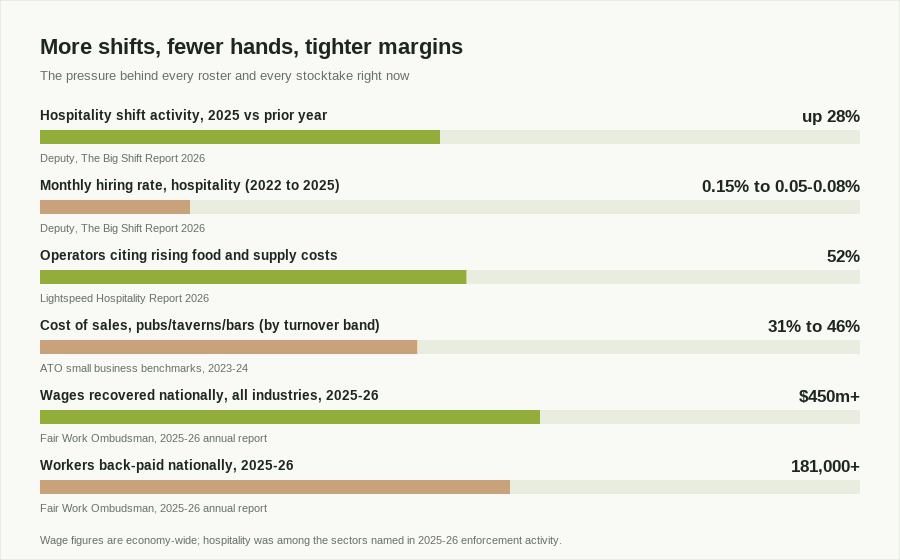
What that means on the floor: more shifts need filling with fewer people to fill them, so a roster built in a hurry is more likely to breach the award without anyone noticing until payday. And with cost of sales already running a third to nearly half of turnover, a stock variance that goes unnoticed for a month is not a rounding error - it is real money.
Can AI actually build a compliant roster for a hospitality venue?
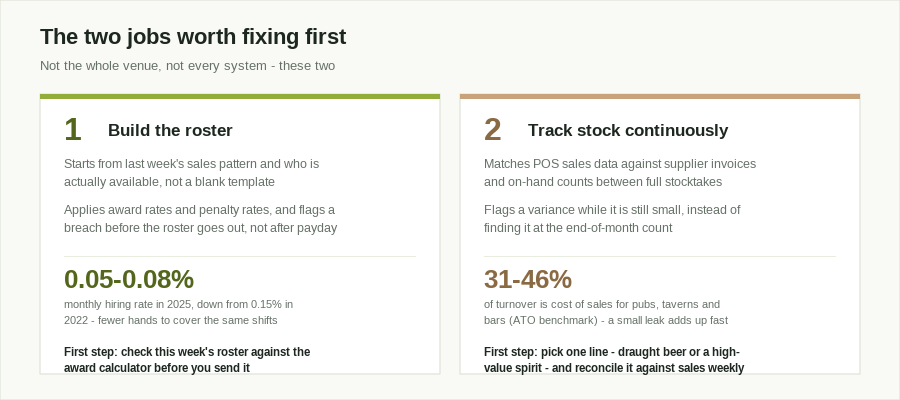
Yes, for the first draft. A rostering tool that is genuinely built for hospitality starts from your sales history and who has told you they are available, builds a draft roster against that, applies the correct award, casual loading and penalty rates as it goes, and flags a likely breach before the roster is sent - not after someone queries their pay.
What it does not do is replace you checking it. Every rostering vendor worth using says the same thing in the fine print: treat the AI draft as a draft, and check pay against the current award rates before you finalise it. That is not a knock on the tool - a roster is one of the few places where a software mistake turns directly into an underpayment claim, and the Fair Work Ombudsman’s enforcement activity through 2025-26 shows that scrutiny of hospitality pay is not easing off.
- It drafts from real numbers, not a blank template. Last week’s sales pattern and this week’s available staff, not a start-from-scratch roster every Sunday night.
- It applies the award as it builds, not after. Base rates, casual loading, and penalty rates calculated against the shift, with a flag raised before the roster goes out if something looks wrong.
- It still needs your sign-off. You are checking a draft against your knowledge of the floor, not approving a black box.
Does AI actually save time on stock takes?
Partly, and it is worth being honest about which part. AI will not walk the floor and count your bottles for you. What it does is keep a running number between full counts - matching what the POS says you sold against what the supplier says you bought - so that by the time you do the physical count, you already know roughly what you should find and where to look if the number is off.
| Job | What AI actually does | What still needs a person |
|---|---|---|
| Daily reconciliation | Matches POS sales against expected stock depletion overnight | Nothing - this can run unattended |
| Variance flagging | Flags a line that is drifting out before the month-end count | Deciding whether it is theft, over-pour, or a counting error |
| Reorder suggestions | Drafts a reorder list from sales trend and lead time | Checking it against what you actually know is coming up (a function, a quiet week) |
| The physical count | Nothing | Someone still has to count the bottles |
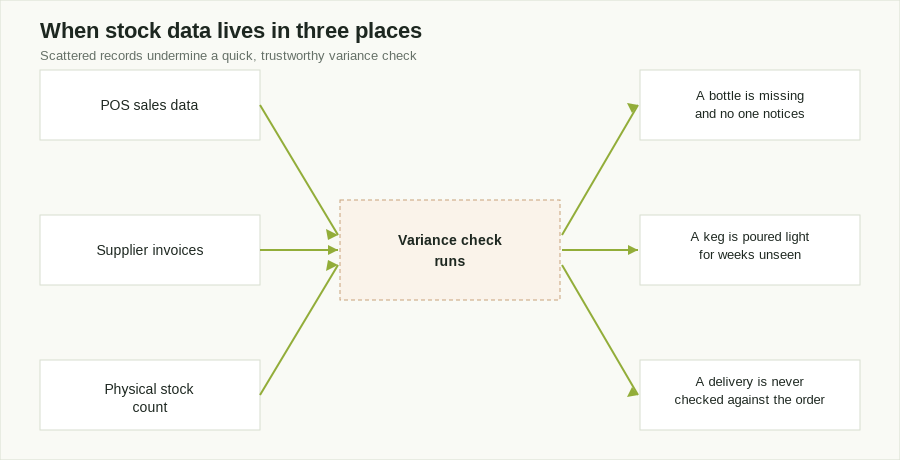
With cost of sales at 31% to 46% of turnover on the ATO’s own benchmark for pubs, taverns and bars, a line that drifts for a month before anyone notices is not a small thing. Catching it at day three instead of day thirty is the actual value - not replacing the stocktake, just making it a confirmation instead of a surprise.
Why does this go wrong at some venues and not others?
Almost always because the three numbers a reconciliation needs - POS sales, supplier invoices, and the physical count - live in three different places that do not talk to each other. If your POS exports to a spreadsheet, your supplier invoices sit in an email inbox, and your stock count is on a clipboard, no tool can reconcile them automatically, because there is nothing for it to reconcile against. We cover this gap in more detail in Fix the data first - then AI works - it is the same pattern whether the business is a venue, a trade, or a professional practice.
The same applies to rostering. If your availability list lives in a group chat and your award interpretation lives in someone’s memory, a rostering tool has nothing reliable to build a draft from. Fixing that is not a technology project - it is deciding that availability, sales history, and stock counts each live in one place, consistently, before any AI tool goes near them.
Where should a hospitality venue start with AI?
Pick whichever of the two jobs - rostering or stock - is costing you more time or more money right now, and start there, not both at once.
- If it is rostering: count how long building next week’s roster actually takes you, then check whether your availability and sales data already sit in one system or three.
- If it is stock: pick one high-value line - a draught beer, a premium spirit - and reconcile it against POS sales weekly for a month before you decide whether a continuous-tracking tool is worth paying for.
- Either way, do not sign up for a system built for retail or warehouses and relabelled for hospitality. The award logic and the stock patterns are different enough that a generic tool will get both wrong.
Our complimentary AI-Readiness Data Check takes about ten minutes and tells you plainly whether your rostering and stock data already sit in one place well enough to support an AI tool, or what needs fixing first - before you spend on anything.
Frequently asked questions
Can AI actually do the rostering for a hospitality venue?
It can draft the roster from your sales history and staff availability, and apply award rates as it goes, flagging a likely breach before you send it. You still need to check the draft - treat it as a first pass, not a finished roster.
Does AI replace the physical stocktake?
No. It keeps a running reconciliation between POS sales and supplier invoices so a variance shows up early, but someone still has to count the stock on the shelf.
How much does cost of sales matter for a pub or bar?
The ATO’s small business benchmark puts cost of sales at 31% to 46% of turnover for pubs, taverns and bars, depending on size. A business well outside that range is more likely to draw closer attention from the ATO, and a stock variance that drifts unnoticed for a month is real money either way.
What is the first task to automate - rostering or stock?
Whichever is costing you more hours or more money right now. Count it for a week before deciding, rather than guessing.
Is AI rostering software safe from a Fair Work compliance point of view?
The tool can apply award rates and flag likely breaches, but the employer remains responsible for what gets paid. Check the draft against current award rates before you finalise it, the same way you would check any new system.