
AI for allied health clinics: cutting no-shows with better reminders
Short answer: AI for allied health clinics earns its keep in one specific job: sending an automatic reminder at a set interval before every appointment, with a one-tap way for the patient to confirm or reschedule, instead of leaving reminders to whoever has a spare ten minutes to call. Studies on automated text reminders have found reductions in no-shows of roughly 19% to 38% compared with no reminder at all. It will not fix a patient who genuinely cannot make it, and it will not replace the clinical judgement about who needs a follow-up call instead of a text. Turn the reminder on first - it is the cheapest, fastest fix available before you spend on anything bigger.
A physio, podiatry or psychology appointment that goes unfilled is not a minor inconvenience - it is 30 to 60 minutes of paid clinician time that nobody can bill, on a day that is already booked out weeks in advance. AI for allied health clinics gets pitched as a broad fix for “patient engagement”, but the actual task worth automating first is much narrower: making sure every booking carries its own reminder, automatically, with an easy way for the patient to act on it.
Why do allied health clinics lose so many appointments to no-shows?
Three things compound at once: no-shows are more common than most clinic owners assume, each one has a real dollar cost, and the usual fix - a staff member calling to remind people - does not scale once the books are full.
| Source | What it found |
|---|---|
| BMJ Open, time-driven activity-based costing study, Queensland metropolitan hospital | Non-attendance rates of 8% and 10% across two physiotherapy outpatient clinics (2018-2021); projected annual cost of responding to non-attendance at one clinic reached roughly $115,000 |
| PMC review of physical and occupational therapy studies, Australia and the UK | No-show rates ranging from 11% to 31% across the studies reviewed |
| BMC Ophthalmology reminder trial | Non-attendance was 11.2% among patients sent a text reminder versus 18.1% among those who were not - a reduction of roughly 38% |
| NSW Government Behavioural Insights Unit, hospital reminder trials | Reminders reduced no-shows by 19% at one hospital and by almost 34% at two others; a UK study using cost-framed SMS reminders cut no-shows by 32% |
| Nookal (Australian allied health practice software, vendor-reported) | 1.8% no-show rate for online bookings versus 5.9% for phone bookings |
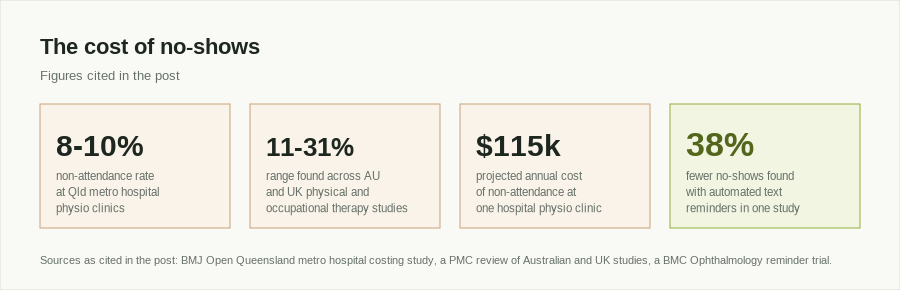
What that means for a clinic: even at the low end of 8%, a clinic seeing 40 patients a day is losing three to four appointment slots daily to no-shows - slots that could have gone to someone on the waitlist if the clinic had known early enough. At the higher end reported in some studies, that is closer to one appointment in three.
Can AI reminders actually cut no-shows for a clinic?
Yes, for the reminder itself and the easy way to respond to it. Not for the reasons a patient misses an appointment in the first place.
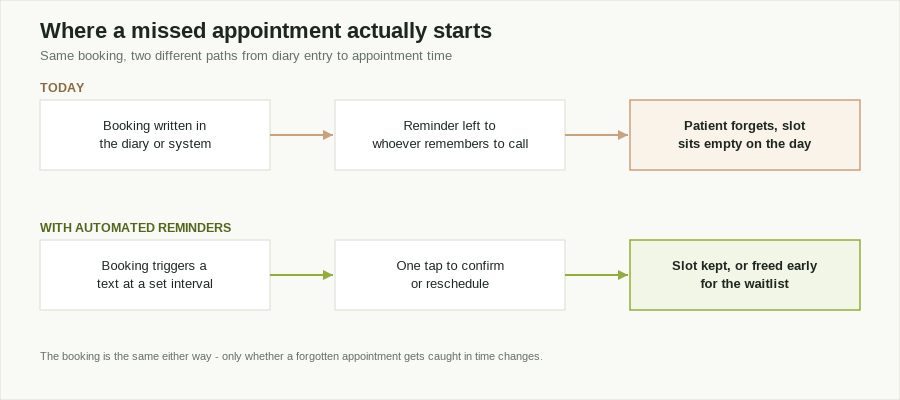
- It sends the reminder automatically, every time, at the interval you set. No staff member has to remember to call, and no patient gets skipped because the front desk was busy with a walk-in.
- It gives the patient a one-tap way to confirm or reschedule. A reply or a link in the text, not a callback during business hours - which is why the studies above show reminders with an easy response option outperforming a plain notice.
- It frees the slot early enough to actually refill it. A cancellation caught two days out can go to someone on the waitlist. A no-show discovered at the appointment time cannot.
- It still needs a person for the patient who is genuinely struggling to attend. Transport, cost, pain levels, or simply forgetting why they were referred - a text does not fix any of that. That conversation is a job for reception or the clinician, not the reminder system.
What else does this actually fix besides the no-show itself?
Once reminders are automatic, the same system usually does three more things worth knowing about - and one thing it will not do.
| Job | What AI actually does | What still needs a person |
|---|---|---|
| Reminder timing | Sends at a fixed interval (commonly 24-48 hours out) for every booking, with no staff time spent | Deciding the right interval for a given service - a first assessment may need a longer lead time than a standing weekly session |
| Rescheduling | Offers the next available slot by text reply, without a phone call | Judging whether a repeatedly rescheduling patient needs a different conversation about the treatment plan |
| Waitlist fill | Flags a freed slot to whoever is next on the waitlist automatically | Deciding who on the waitlist is clinically appropriate for that slot |
| The patient relationship | Nothing changes about who the patient actually sees or trusts | The clinical relationship, and any conversation about why appointments keep being missed |
With reductions of roughly 19% to 38% reported across the reminder studies above, the value is not a fancier booking app - it is the handful of slots a week that stop silently disappearing, which on a full book is the difference between a clinician sitting idle and seeing the next person on the waitlist instead.
Why does this work at one clinic and not the next?
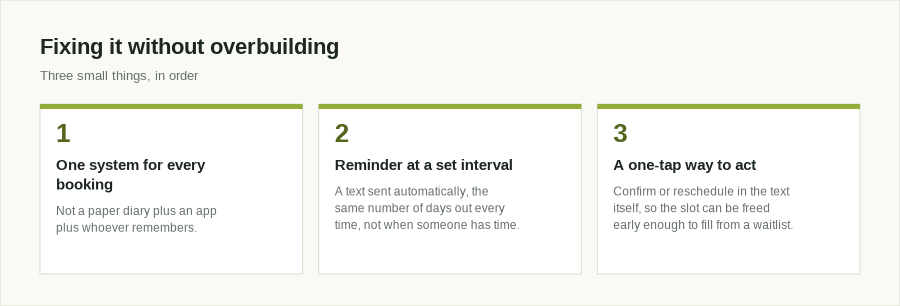
Almost always because the booking data is split across more than one place. If some appointments are booked through an online system, others are written in a paper diary at reception, and a few live only in a clinician’s own notebook, there is nothing for a reminder system to send from - it cannot text a booking it never saw. We cover this gap in more detail in Fix the data first - then AI works; it is the same pattern whether the business is a clinic, a trade, or a professional practice.
The fix is not a smarter reminder tool. It is deciding that every booking - online, phone, and walk-in - lands in the one system before any automated reminder goes near it. The same after-hours pattern shows up in Automating quoting, scheduling and after-hours enquiries for service businesses and in AI answering services vs. a real receptionist: what actually stops missed calls.
Where should a clinic owner start with AI?
Start by measuring the thing you are trying to fix, not by buying a new booking platform.
Pull last month’s appointment book and count how many slots actually went unfilled, and how many of those bookings had no automatic reminder attached at all. Most clinic owners have never done this and are surprised by the number.
Our complimentary AI-Readiness Data Check takes about ten minutes and gives you a plain read on whether your booking data already sits in one place well enough to support automatic reminders, or what needs fixing first - before you spend on anything.
Frequently asked questions
Do automated reminders actually reduce no-shows at a clinic?
Studies on automated text reminders have found reductions ranging from roughly 19% to 38% compared with no reminder, with the strongest results coming from reminders that also give an easy way to confirm or reschedule, not just a notice.
What causes most no-shows at an allied health clinic?
Peer-reviewed studies on physical and occupational therapy put no-show rates between 11% and 31%, and a Queensland metropolitan hospital costing study found rates of 8% to 10% across two physiotherapy clinics. The underlying causes vary by patient - transport, cost, and simply forgetting are all common.
Can AI replace the phone call for a patient who keeps missing appointments?
No. A text reminder catches the patient who simply forgot. A patient who repeatedly misses appointments usually has a reason worth a real conversation - that stays with reception or the clinician.
How much does a no-show actually cost a clinic?
A Queensland metropolitan hospital study projected costs of responding to non-attendance at around $115,000 a year for one physiotherapy clinic, driven mainly by clinician time that cannot be billed and the administrative work of rebooking.
What is the first thing a clinic should automate?
Automatic reminders at a fixed interval before every appointment, with a one-tap way to confirm or reschedule. It is the narrowest, cheapest fix, and it depends on nothing more than getting every booking into one system first.